
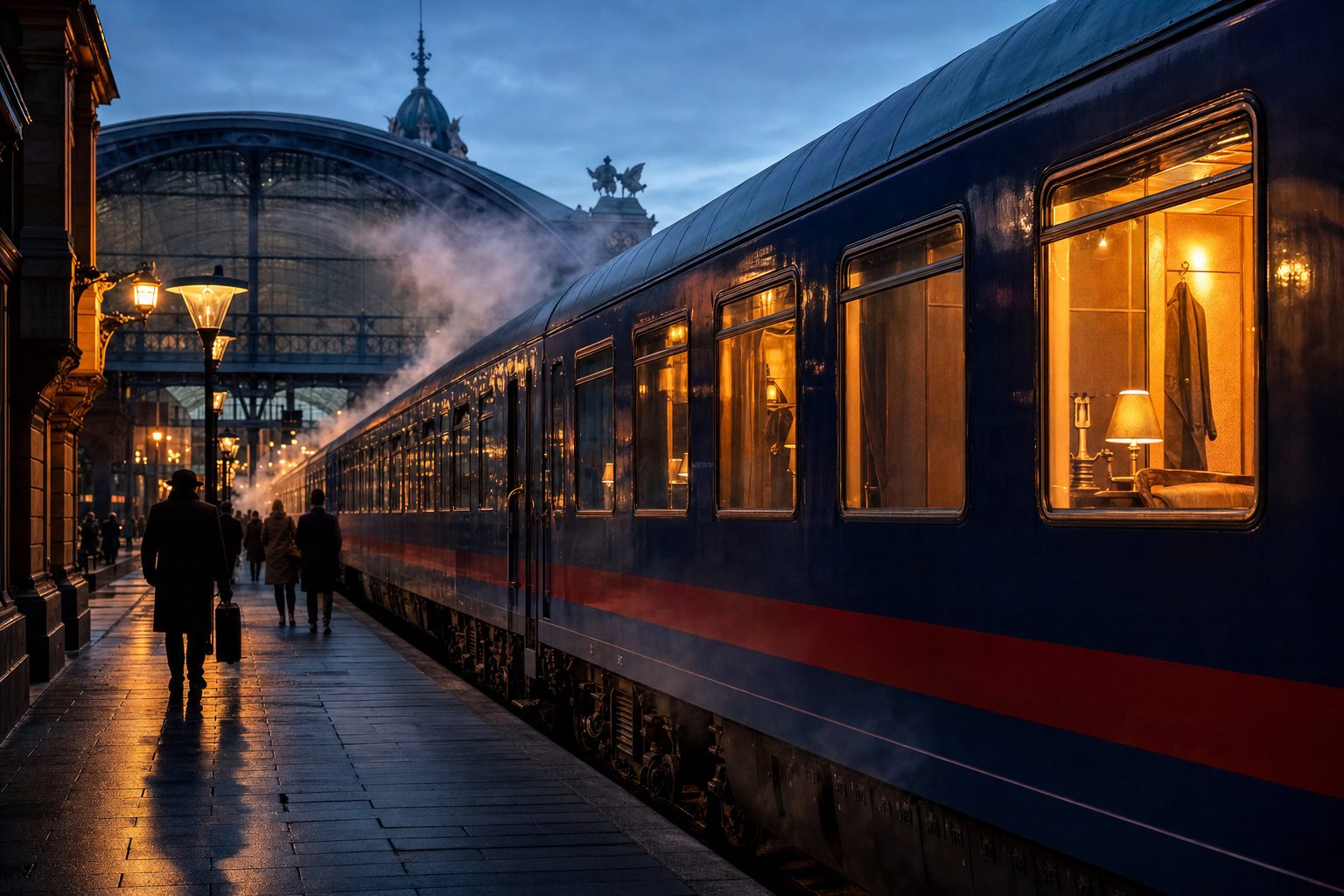
There is a particular magic to falling asleep in one country and waking in another. You draw the little curtain, the platform lights slide away, and the rhythm of the rails does the rest; somewhere past midnight the train crosses a border you never see, and in the morning a steward knocks with coffee as a different landscape scrolls past the window. For a generation of travellers this was simply how you crossed Europe. Then, almost overnight, it nearly disappeared. Now, just as suddenly, it is back — and the comeback is one of the more surprising travel stories of the decade.
As recently as the mid-2010s the European night train looked finished. Budget airlines had undercut the sleeper on price and speed; high-speed day trains had swallowed the medium-haul routes; and the rolling stock was ageing into unreliability with no one willing to pay for replacements. Famous routes were quietly axed. Obituaries were written. And then the line on the graph turned around. Today there are more night-train routes running in Europe than at any point this century, with new ones announced almost every season and berths that sell out months in advance. Understanding why tells you something about where travel as a whole is heading.
Why the sleeper came back
Three forces converged. The first was climate: as the environmental cost of short-haul flying came under scrutiny, a night train that emits a fraction of the carbon per passenger went from quaint to quietly virtuous, and governments began funding routes as public infrastructure rather than leaving them to sink or swim. The second was simple economics for the traveller — a night train is transport and a hotel room in one. Board at nine, arrive at seven, and you have crossed a continent while saving the price of a night's accommodation and a precious day of your trip.
The third force was the one no spreadsheet predicted: people actually missed it. There turned out to be deep, slightly irrational affection for the romance of the sleeper — the sense of an adventure that begins the moment you board rather than at the destination — and that affection translated into demand the instant the routes reappeared. A few national operators bet on it, ordered new rolling stock, and were rewarded with trains running close to full. Success bred imitation, and the network began to knit itself back together.
"A flight takes you from airport to airport. A night train takes you from the middle of one city to the middle of another, while you sleep. Once you reframe it as a moving hotel, the maths changes completely."
What a night aboard is actually like
Romance aside, it helps to know what you're buying, because the experience varies enormously with the class of accommodation — and choosing the wrong one is the single most common way people come away disappointed. Broadly there are three tiers, and the gap between them is wide.
Seats
At the bottom sit reclining seats, much like a coach or an aeroplane. They are cheap, and on a short overnight hop with low expectations they are fine, but do not imagine you will sleep well: the lights, the movement and your fellow passengers conspire against it. We'd reserve seats for the young, the broke, or the genuinely short hop where arriving a little frayed doesn't matter.
Couchettes
The middle tier — couchettes — is where most travellers should look. These are simple padded bunks, four or six to a compartment, with a pillow, a blanket and a shared corridor washroom. You share with strangers (single-sex compartments are usually bookable), and there is a sociable, slightly old-fashioned charm to it. For the price, a couchette is the sweet spot: you can lie flat, you can sleep, and it costs a fraction of the private option.
Sleepers
At the top are private sleeper cabins, with a proper bed or two, a sink, sometimes a private shower and toilet, and breakfast brought to your door. This is the version that lives up to the photographs, and on the newest trains it is genuinely lovely — close to a boutique hotel room that happens to be moving at speed through the Alps. It costs accordingly, but split between two people and offset against the hotel night you're not paying for, it is far from extravagant.
Our rule of thumb
Book a couchette if you want the experience at a fair price and don't mind sharing; book a private sleeper if you're travelling as a pair, value a real night's sleep, or have an important morning ahead. Skip the reclining seat unless the journey is short or the budget is non-negotiable.
How to book without the headaches
The revival has outpaced the booking systems, and this is where newcomers stumble. Night-train tickets are not always sold the way flights are, and a few habits save a lot of grief.
- Book early — really early. Popular sleeper cabins on scenic routes open for sale months ahead and the best ones vanish first. If your dates are fixed, reserve the moment the window opens.
- Go to the operator where you can. Buying directly from the railway that runs the train is usually cheapest and makes changes easier. Third-party sites are convenient for complex itineraries but often add a fee.
- Understand what "a ticket" includes. On some routes the journey fare and the berth reservation are separate purchases; miss the second and you have a valid ticket but nowhere to sleep.
- Mind the through-booking. If your trip spans two operators, a single combined ticket protects you if the first train is late and you miss the connection. Separate tickets do not.
The routes worth planning a trip around
We won't pretend to a definitive ranking — the network changes too fast — but a few categories of journey reliably deliver. The Alpine crossings are the showstoppers: board in a flat northern city and wake to mountains filling the window, a transition no flight can offer. The long diagonal runs that link northern and southern Europe turn what would be a tedious travel day into a single comfortable night. And the routes that reconnect capitals which had lost their direct link carry a certain civic pride; locals use them, which is always the sign of a route that works rather than a tourist novelty.
The smartest way to use the night train, we've found, is as the connective tissue of a longer rail trip rather than a one-off gimmick. String two or three together with day trains in between, and you can cross a remarkable amount of the continent without a single airport, each overnight leg saving you a hotel and delivering you rested into a new city centre at breakfast. It is, when it clicks, the most civilised travel there is.
Night-train packing notes
- Earplugs and an eye mask. The two cheapest upgrades to your night's sleep, especially in a couchette.
- A small day-bag with what you need overnight, so you're not wrestling your main luggage in a dark compartment.
- Snacks and a water bottle. Catering ranges from a full dining car to nothing at all; don't assume.
- A power bank. Outlets exist on newer trains but aren't guaranteed in every berth.
- Slip-on shoes for the midnight corridor trip to the washroom.
When people ask whether the night train is worth it, the honest answer is that it depends on what you want from a journey. If your only metric is arriving as fast as possible, a flight will usually win. But if the journey is part of the trip rather than an obstacle to it — if you'd rather sleep your way across a continent and wake somewhere new than queue at a 5am security line — then the sleeper isn't nostalgia. It's the better way, and Europe is finally remembering that.
Flying in to start a rail trip?
Find the cheapest flight to your gateway city, then let the night trains take it from there.
Open the fare finder ✈